It is the developer's first game, and they started with no coding experience. In a devlog on itch.io on June 28 they wrote that they had begun without a programming or game development background. In an interview with the Korean games site Gamemeca, published November 4, the developer said they grew up abroad, studied computer science in the UK, dropped out and moved back to South Korea on their own. A sibling with a computer science background introduced them to vibe coding (describing what you want and letting AI write the code), and work began around October 2025. "At first, I didn't even want to try when I heard the word coding," the developer told Gamemeca (Gamemeca's machine translation from Korean). The steps below are pieced together from the developer's own posts and the interviews and posts that outlets quoted. The developer hasn't published a single build log, and AIGamer hasn't been able to read their posts on Reddit, where some of these comments first appeared.
Slotbound
- Windows
- macOS
Summary
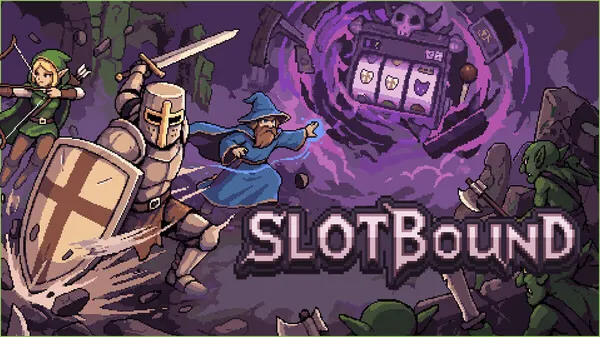
Slotbound is a single-player roguelite auto-battler for Windows and macOS from Optima Arch, a one-person studio in South Korea. It was released on Steam on November 12, 2026. Each turn the player spins a 3x3 slot machine; matching lines summon pixel-art units, which then fight waves of enemies on their own. Weaker units can be absorbed into stronger ones, every unit rolls random stats, and Items and Cores let the player bend the odds before judgement and boss waves. The Steam page lists 64 achievements, full controller support and 13 interface languages. It costs $9.99, 10% off in an introductory offer that Steam says ends November 26, and a free Windows demo has been on Steam since July 10. On November 20 the Steam page showed 79% of 1,491 user reviews as positive (Mostly Positive).
Trailer
How it was made
Step 1 Start with a square
The developer told Gamemeca that their first prompt was to make a game with a square moving around under WASD controls. From there they kept adding to it, one request at a time, with no plan to write code themselves.
Step 2 Let AI write every line
The developer has said AI generated 100% of the game's code. They named Cursor and VS Code Copilot for programming and said they alternated between ChatGPT, Claude and Gemini (as quoted by iXBT.games). Their own job, they said, was game design, balance, making the visuals hang together, and polish.
Step 3 Make the art with AI, then rework it
For graphics they mainly used Pixelab and Google's Gemini Nano Banana, according to iXBT.games. In July the developer said AI made much of the UI, backgrounds, animations and pixel art, with only a small share of assets bought or edited by hand. The Steam disclosure says every AI-made asset was reviewed and reworked to match the game's art style.
Step 4 Ship a demo early
A playable demo went up on itch.io by late June and on Steam on July 10. The developer says it briefly reached #2 among all Steam demos, and Gamemeca reported it at 82% positive. The demo kept getting big updates; one in October added a new unit, a second stage, controller support and 8 languages. The developer told Gamemeca they still think releasing a demo was the right call.
Step 5 Deal with copycats
In September a mini-game on China's Douyin, "Army Annihilation War", copied Slotbound's interface, art and units almost exactly and added in-app payments, the developer told Gamemeca. A Chinese fan reported it for them and it was taken down; a second copy appeared on WeChat in October and was reported on October 20. The developer believes both were made by decompiling the demo with AI. That hasn't been confirmed.
Step 6 Get through Steam review
The game passed 100,000 wishlists on September 27, with Early Access set for November 10. The developer submitted the launch build on October 18. The first review took 13 days and rejected the build, and the resubmission was still waiting on launch day, they wrote in Steam posts on November 9 and 11. Once approved, it launched as a full 1.0 rather than in Early Access, and the developer dropped plans for a paid supporter pack because of the delay.
Step 7 Patch fast after launch
The developer pushed nine updates in the first three days, mostly from player reports: easier early stages and bosses, fixes for older Steam clients and some Windows setups, Turkish, and new keyboard shortcuts.
By the developer's own figures, Slotbound sold 50,000 copies and grossed $356,000 in its first 48 hours, with a peak of 9,377 players at once (a post on X quoted by MeinMMO on November 17). It passed 100,000 copies sold on November 16, three days after launch, and 200,000 on November 19, according to the developer's Steam announcements. Player counts kept climbing after that: Markan, a Steam data site, recorded a peak of 32,543 concurrent players on November 18.
The developer hasn't shared revenue past the first 48 hours. By our own arithmetic, 200,000 copies at the $8.99 launch price come to about $1.8 million before regional pricing, discounts, refunds, sales tax and Steam's 30% cut. The developer will take home much less, and how much less isn't public. Estimates from Steam data sites, which work from review counts, vary widely and haven't caught up with the developer's own sales figures.
One detail stands out on the store page: the Steam AI disclosure mentions visual assets and promotional materials, but not code, though the developer has said AI generated all of it. The disclosure on the Steam demo adds that no generative AI runs while the game is being played. The itch.io demo page carries itch.io's "AI Assisted" label for code, graphics and sounds. The developer has been open about the AI use since the first demo, and reviews have stayed mostly positive; the Russian site iXBT.games ran its launch story under a headline calling it "proper AI slop" (our translation of its English version) while noting how well players received it.
Not to be confused with a different, unrelated Slotbound: an in-development browser incremental RPG by Nyxthetics and acidelic on itch.io. Optima Arch says they're still updating Slotbound with bug fixes, balance changes and new content.
Sources
Details come from the developer's own posts and pages credited below.
- Optima Arch (Steam): Slotbound on Steam (store page and AI Generated Content disclosure)
- Optima Arch (Steam): Slotbound Demo on Steam (AI Generated Content disclosure)
- OptimaArch (itch.io): Slotbound playtest demo (AI disclosure: code, graphics, sounds)
- OptimaArch (itch.io forum): Slotbound devlog: first game, no programming background (June 28, 2026)
- Gamemeca (Kim Hyung Jong): Interview: the developer's background, vibe coding and the Douyin and WeChat clones (November 4, 2026; English machine translation)
- iXBT.games (Boris Piletskiy): The developer on making the demo almost entirely with AI (July 27, 2026)
- iXBT.games (Boris Piletskiy): Launch coverage quoting the developer's AI tools (November 14, 2026)
- MeinMMO (Benedikt Schlotmann): Quotes the developer's first-48-hours figures from X (November 17, 2026)
- Optima Arch (Steam news): Slotbound Has Sold 200,000 Copies! (November 19, 2026)
- Optima Arch (Steam news): Slotbound Has Sold 100,000 Copies! (November 16, 2026)
- Optima Arch (Steam news): Slotbound 1.0 Is Out Now! (November 13, 2026)
- Optima Arch (Steam news): A Personal Update on Slotbound's Delayed Release (November 11, 2026)
- Optima Arch (Steam news): Slotbound v0.4.0: Early Access date and 8 new languages (October 5, 2026)
- Optima Arch (Steam news): Slotbound Has Reached 100,000 Wishlists! (September 27, 2026)
- OptimaArch (@OptimaArchGames) on X: Launch figures: copies sold, gross revenue and peak players in the first 48 hours
- OptimaArch (@OptimaArchGames) on X: Demo reached #2 among all Steam demos
- OptimaArch (@OptimaArchGames) on X: Slotbound official trailer
- Markan: Slotbound Steam data: daily peak concurrent players
- OptimaArch on YouTube: OptimaArch channel (trailers and development shorts)
- Nyxthetics and acidelic (itch.io): Slotbound, the unrelated browser incremental RPG of the same name
Image: Optima Arch
Written in our own words; quotes are marked and credited. How we report