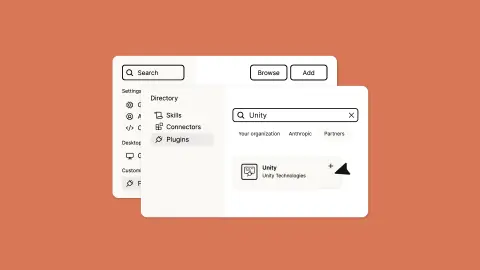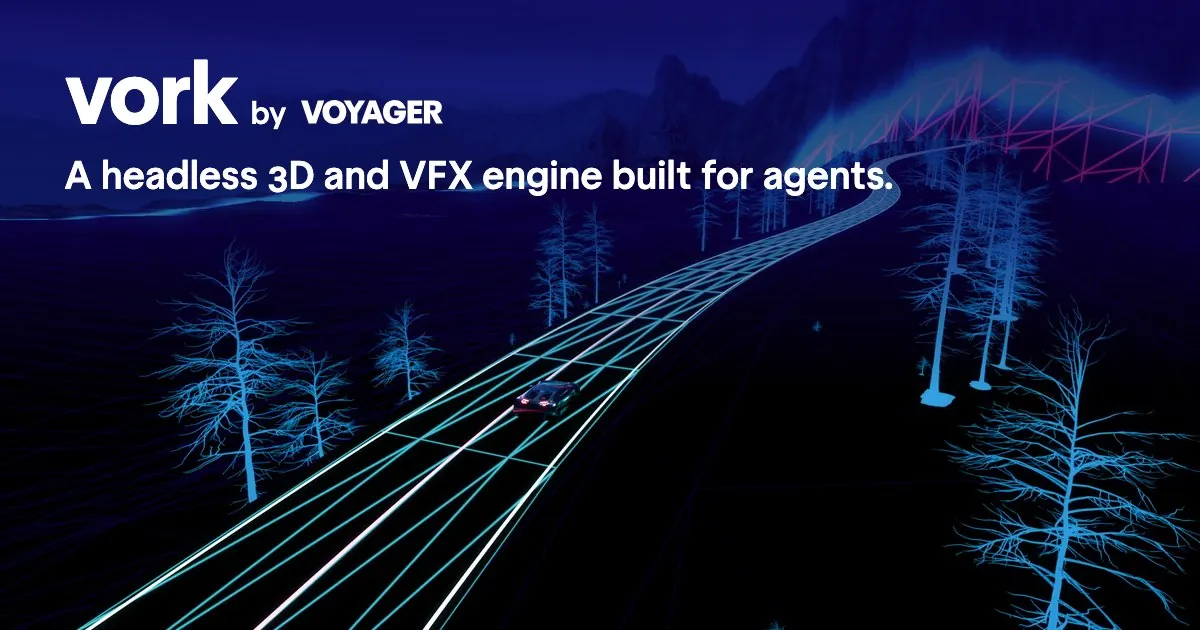
Voyager released vork, a headless 3D and VFX rendering engine meant to be run by AI coding agents rather than people, on November 6, 2026. The company announced the research preview on its product page and in a GitHub repository, and co-founder Ravi Parikh (@ravisparikh) introduced it in a post on X.
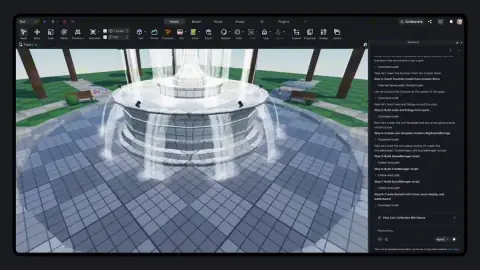
vork has no editor or window. An agent writes a scene as JSON, renders it from the command line, checks the image and edits the scene. According to the project's README, scenes can also carry small GPU programs in the Slang shading language that control materials, cameras, lighting, simulation and compositing. Voyager says the getting-started help an agent reads is about 2,500 tokens, including a complete example scene.
Version 0.1.0 is free during the preview, including for commercial use. Its license calls it source-available, not open source: you can modify it for your own use but not sell it, share modified copies or run it as a hosted service. It needs Windows or Linux with a recent NVIDIA GPU that supports hardware ray tracing, or an Apple Silicon Mac on macOS 26. Voyager also rents cloud GPUs that run it, billed by the second. vork has an entry in AIGamer's Resources directory.
Why it matters: Agents that make 3D shots today mostly drive tools designed for people, such as Blender. vork builds the renderer around the agent's write, render and check loop instead, which could suit trailer shots, key art or effects tests. Voyager's blog says vork is not a game engine and describes no input handling or gameplay runtime.
Caveat: The speed and token figures are Voyager's own, and AIGamer hasn't tested vork. Parikh's post claims vork is 2 times more token-efficient than Blender, Unreal Engine and Houdini and renders up to 24 times faster, without naming a baseline for the 24x; the README repeats neither. The post also gives Blender's EEVEE 31 minutes for a million-bird shot vork rendered in 97 seconds on one NVIDIA L4. The README projects 13 to 18 minutes for EEVEE at matching samples, excludes vork's setup and warmup, and says these are not equal-quality comparisons. Its path tracer was slower than Blender's Cycles in both named tests.
The preview ignores fog and volumes, and large scenes or dense transparency can fail, including on Mac. Voyager lists fog, volumes, broader simulation and better reliability as next, with no release date promised.