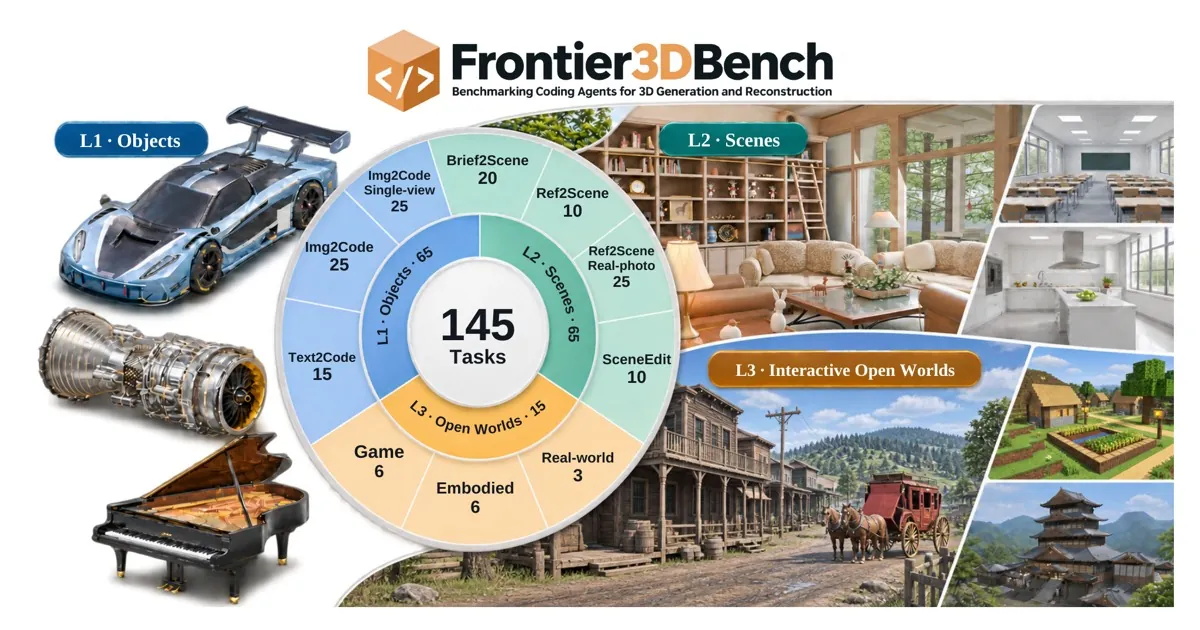
Researchers from Einsia.AI's Navers Lab and Tsinghua University released Frontier3DBench on November 6, 2026: a set of 145 tasks that asks coding agents to build 3D objects, scenes and interactive worlds as working Blender and Unreal Engine 5 projects. The results come from the team's own preprint paper and project page, which Einsia (@EinsiaAI) announced in a post on X.
There are three levels: 65 object tasks and 65 scene tasks in Blender, plus 15 open-world tasks in Unreal Engine 5. Agents start from text briefs, reference images, real photos or an existing scene, and must deliver editable .blend or .uproject files rather than pictures. Each submission is rendered, inspected and run, then scored on appearance, structure and behavior. The overall score weights the levels 30%, 30% and 40%.
Eleven model and harness pairings were tested, all at their highest reasoning effort. OpenAI's GPT-6.1 Sol running in Codex scored highest at 66.02 out of 100, ahead of GPT-6 Astra in Codex at 63.85 and Claude Opus 5.5 in Claude Code at 62.29. Astra had the best Unreal Engine score, 61.28, and Opus 5.5 had the top text-to-object score, 84.05. Doubao Seed Evolving came last at 42.94.
According to the paper, every setup scored lower when matching a reference than when generating from a text brief, for both objects and scenes. Across all 165 Unreal submissions, individual mechanisms averaged 83.08, but motion clearance averaged 20.82 and stateful multi-step workflows 30.26.
Why it matters: Developers already use Claude Code and Codex to block out props and levels. This benchmark checks whether the result is an engine project someone can open and keep editing, not just a good-looking frame. Its numbers suggest agents can wire up single interactions but still struggle to match concept art or finish a full gameplay sequence.
Caveat: The tasks, scoring and results are Einsia's own and haven't been independently reproduced. Scores depend on the harness and effort setting, and the Unreal level rests on just 15 tasks. We haven't run the benchmark.
The task inputs, generation and evaluation code are on GitHub; the software is Apache-2.0 licensed, while task assets keep their own licenses, and model outputs aren't included. The paper is a preprint and hasn't been peer reviewed.