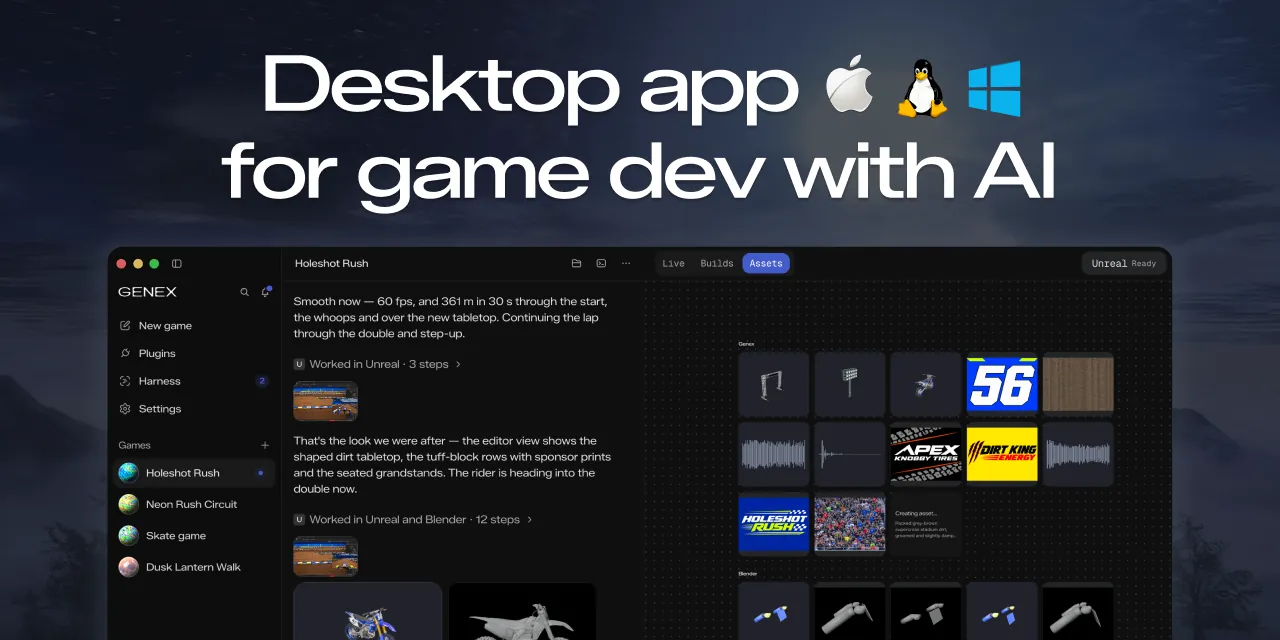
Genex announced an open-source desktop app for building games with AI agents on October 5, RuntimeWire reported. The MIT-licensed app, published on GitHub, is pitched as a customizable "harness" for game development rather than a new engine.
Instead of replacing the coding agents developers already use, Genex adds game-specific tools around them. It connects to Claude through Claude Code, to ChatGPT through Codex, and to local models through Ollama.
Different models can take different jobs: one plans, others build, and visual "judges" check the result. According to RuntimeWire, the app works with existing Claude or ChatGPT subscriptions, so API keys aren't required.
Projects stay as ordinary files on the developer's own machine, not inside a proprietary editor or hosted service. The project's README describes local 3D modeling through a Blender plugin, access to Meshy, Tripo and ElevenLabs through a Genex tools router, and support for custom plugins.
The core scope is narrower than the pitch. Genex targets Three.js games that run in a browser, exported as static web bundles or published through Genex. Its README lists downloads for macOS on Apple Silicon and Linux, plus a Windows preview build that isn't code-signed yet.
The README now also says Mac users can build in Unreal or Godot through those engines' plugins; it no longer lists Unity.
An optional, experimental feature lets the harness try to improve its own prompts, skills and tools, which are stored in a Git repository the app can edit. Genex takes a snapshot before each change, a blind judge compares the results, and a version that fails to start is rolled back. The feature is off by default.
The desktop app is free. RuntimeWire says the paid part is optional asset generation through a Genex plugin, and users still cover their own model subscriptions or local compute.
Why it matters: Genex offers an open, inspectable alternative to closed "prompt-to-game" platforms, aimed at developers who are comfortable working with code and agents. The real test is whether its plan, build and judge loop reliably produces playable games.
Caveat: the project describes itself as early and warns of rough edges. AIGamer hasn't tested it.
What to watch: a signed Windows release and how far the Unreal and Godot support goes beyond browser games.