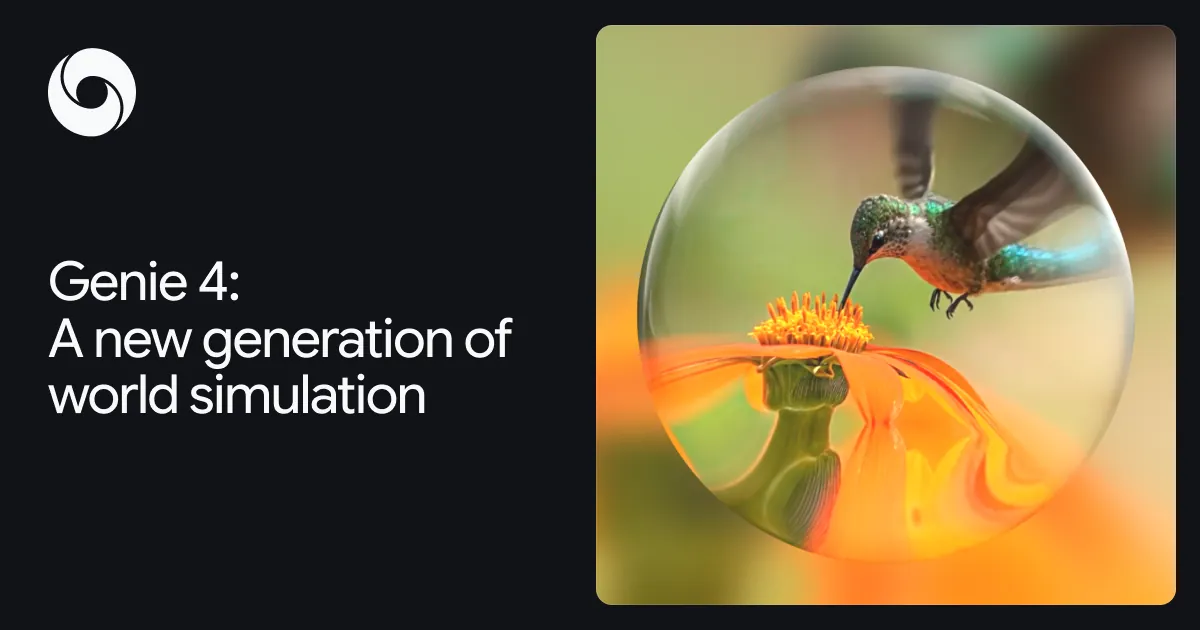
Google DeepMind announced Genie 4, the next version of its real-time interactive world model, in a blog post on October 27. TechCrunch and The Verge also covered the launch.
For now it's a research preview for trusted testers. DeepMind says it will come to Google AI Ultra subscribers through Project Genie, and to early-access partners on the Gemini API and AI Studio through a waitlist.
The main addition is native audio, including music, ambient sound and dialogue. Users can also edit a world with text while it runs, for example changing the weather or the camera, or adding people and objects.
DeepMind says Gemini Omni handles appearance and behavior while Gemini 3.8 Flash keeps the simulation coherent. Scenes now stay consistent for about two minutes, up from about one minute for Genie 3.
DeepMind is pitching Genie 4 for game prototyping and previsualization, as well as for training robots and agents. Its announcement post on X drew about 17,500 likes and 2.1 million views.
The launch came eight days after Viggle released JST-2 on October 19, a world model built in 3D that generates static splat scenes for under a cent. Both companies are betting that generated worlds will become a normal prototyping tool.
Why it matters: two minutes of consistent, controllable world with sound is still far from a shippable game. But it's long enough to test a level idea, a mood or a camera move in seconds instead of days. Live text editing also points toward a way of designing where you describe changes to a running scene.
Caveat: the capabilities are DeepMind's own claims, and AIGamer hasn't tried the model. DeepMind lists current limits including drift and object permanence, on-screen text, audio accuracy and short session lengths.
What to watch: wider API access, which developers will need to find out how well Genie 4 holds up outside DeepMind's demos.