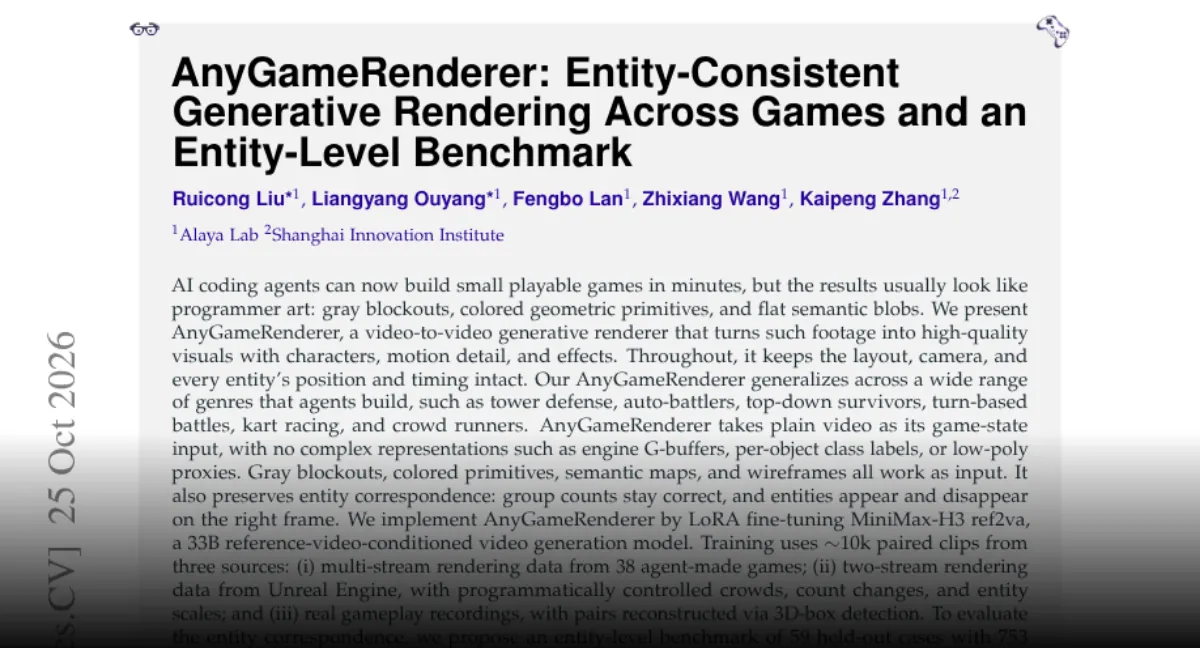
Researchers Ruicong Liu, Liangyang Ouyang, Fengbo Lan, Zhixiang Wang and Kaipeng Zhang posted AnyGameRenderer to Hugging Face Papers on October 22. Their paper describes a model that turns rough "programmer art" gameplay footage into polished visuals, and Glonce also covered it.
Agent-built games usually start with simple visuals: gray blocks, colored shapes and wireframes. The paper asks what happens if developers leave the visuals that way and repaint the footage afterwards.
AnyGameRenderer is a video-to-video generative renderer. It takes gameplay video of gray blockouts, colored primitives, semantic maps or wireframes and outputs polished visuals, keeping the layout, the camera, and each entity's position and timing.
The input is plain video, with no G-buffers (per-pixel scene data from the engine), class labels or proxy geometry. Tested genres include tower defense, auto-battlers, survivor games, turn-based games, kart racers and crowd runners.
The model is a LoRA, a small add-on trained on top of a larger model, in this case MiniMax-H3 ref2va, which has 33 billion parameters. Training pairs came from 38 agent-made games exported from GEAR, crowd scenes rendered in Unreal, and real gameplay.
The authors also built a benchmark that tracks individual entities, with 59 cases and 753 entities. Compared with the base model, temporal match rose from 50.9% to 62.9%, and missed changes in entity counts fell from 34.7% to 21.3%.
What this means in practice: - Separate gameplay from visuals. Agents can build mechanics with simple primitives, which are easier for them to reason about and test. - Treat appearance as a later stage that can be swapped out. - Check that game state survives. Entity-level consistency is what separates a usable renderer from a video that looks good but misrepresents the game.
Why it matters: the paper fits a broader pattern in late October, alongside trompe's level texturing and Hi3D's mesh refinement, of building gameplay first and adding finished visuals later.
Caveat: the results are the authors' own, and this is research on recorded video, not a runtime renderer. About 1 in 5 entity-count changes are still missed, so it isn't ready to drive a live game.
What to watch: whether later versions close the gap on entity-count changes, the clearest barrier to using this kind of renderer in a running game.