The story is written live by large language models. Questner's player guide, which matches the developer's submission, lists three families: Google's Gemini (3.5 Flash-Lite, a standard Gemini, 3.7, 3.8 and 4 Argon), OpenAI's GPT (GPT-6 Luna, GPT-5.6 Luna and GPT-6 Sol) and Anthropic's Claude (Haiku, Sonnet 5 and Sonnet 5.5). The guide points to Gemini for stat-heavy games, GPT for story-led ones and Claude for richer prose; a reply costs 0.6 to 7 messages depending on the model. If the chosen model fails a turn, a backup model steps in. The privacy policy says the models are reached through OpenRouter. Players can also add an AI picture to every turn, for 9 extra messages, or ask for one image; the site doesn't name the image models.
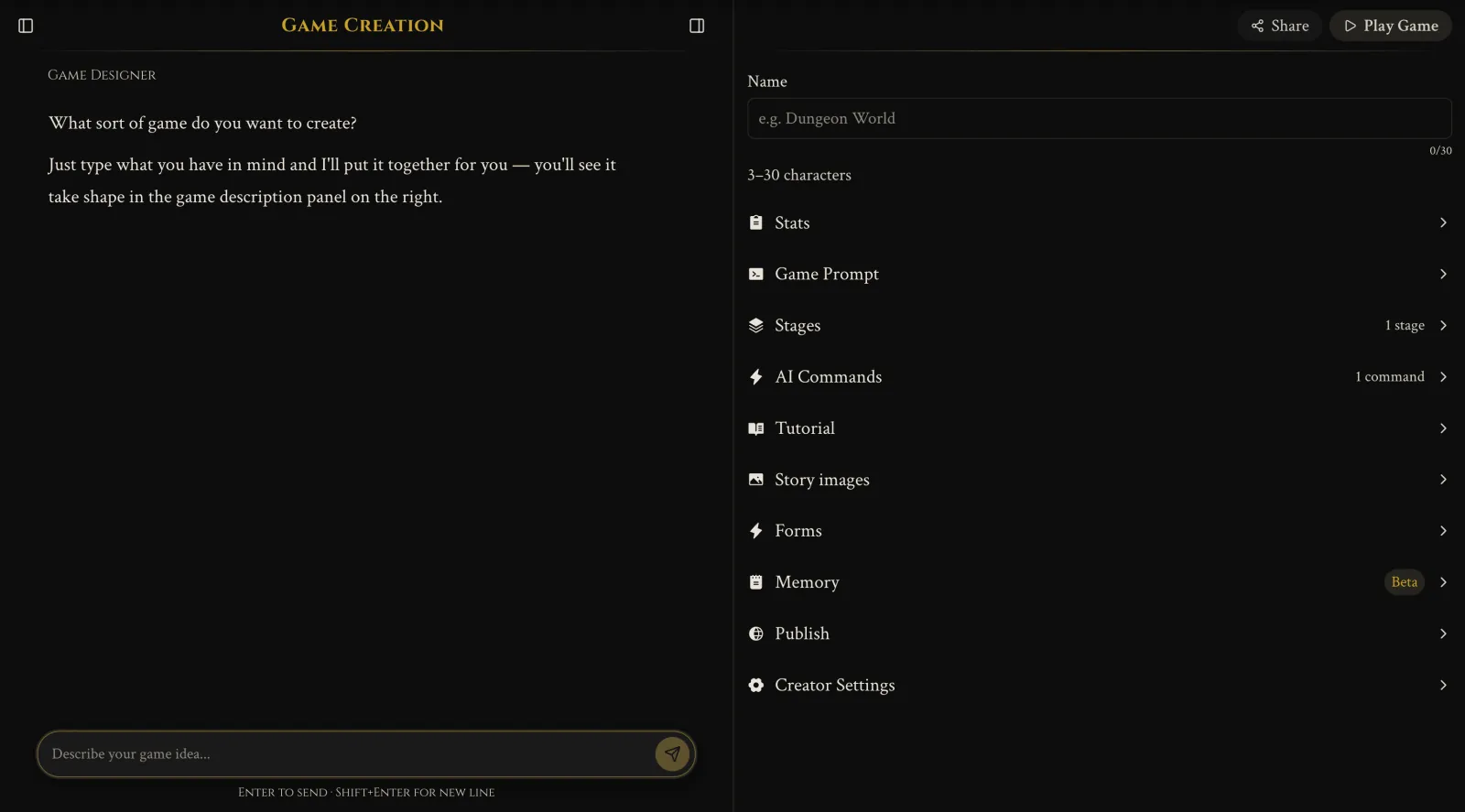
According to the developer, the team's own work is the layer that keeps the AI playing by a game's rules instead of drifting into open-ended chat: story memory, stats, stages, rules and AI commands, plus the campaign creator, the website and the Game Master's prompts. The player guide shows that memory as an editable timeline of key events the narrator rereads each turn. Players with an account can publish their own adventures, and a "Game Designer AI" drafts one from a plain description. The FAQ admits that in long campaigns the AI can forget details, rush ahead or act for the player, and says fixes are in progress.