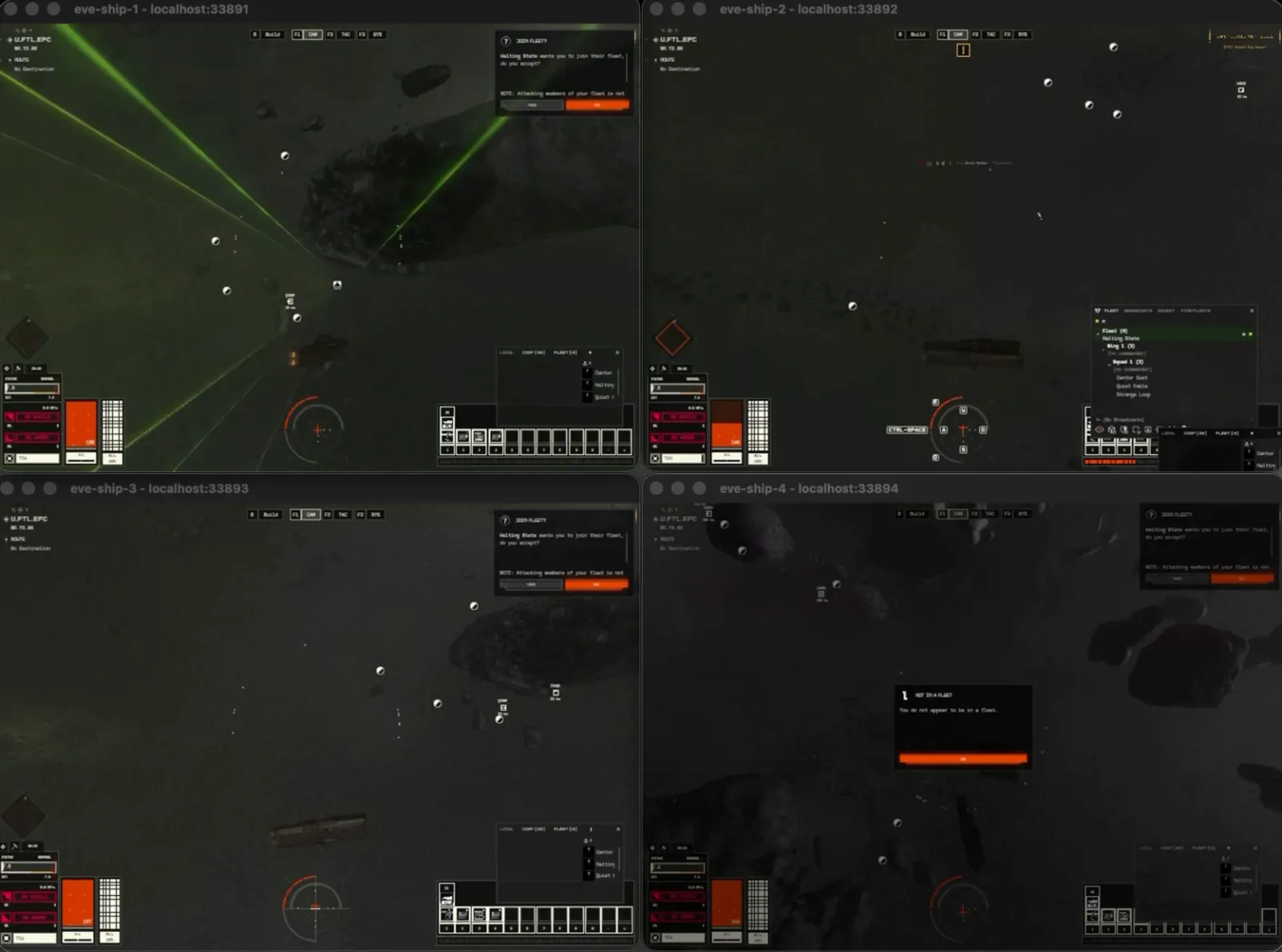
Anthropic's Frontier Red Team published Project EVE, a research post, on November 6, 2026, testing Claude agents as traders on a replayed EVE Online market and as four-agent teams in live EVE Frontier. The work, done with EVE developer Fenris Creations (formerly CCP Games), came out of the Anthropic Fellows Program from April to July 2026.
At Fenris Creations' request, and because automated trading is against the rules, Anthropic didn't trade in the live game. It replayed real player orders from the busiest trade hub, starting each run with 3 billion ISK. Over roughly six-month runs, average earnings rose from about 200% of starting capital for Claude Opus 4.6 to about 600% for Claude Fable 5. Nearly all models bought below an item's usual price and resold soon after. Told to bet on price moves, even Fable 5 profited in only about half its runs.
In EVE Frontier, combat moves too fast for the models, so a developer agent wrote scaffolds, code that automates quick actions like returning fire; models before Fable 5 could barely produce a usable one. On a Fable 5 scaffold, Fable 5 teams finished the tutorial within 12 hours without losing a ship. No team got more than roughly halfway to building a large warship.
In the sabotage test, researchers prompted one agent per team to secretly undermine the mission and warned the other three. Saboteurs took bottleneck jobs and under-reported resources, and teammates "almost never caught it," Anthropic wrote. Monitor agents reading only the public team chat, tuned to falsely accuse at most 5% of the time, caught 30% to 40% of saboteurs on Opus models and 20% on Sonnet 4.6.
Why it matters: For anyone building AI NPCs or agent-driven players, this is a rare look at frontier models in an MMO setting. In Anthropic's tests they coordinated well and traded profitably, needed custom tooling for real-time play, and a deceptive agent was hard to spot from chat alone.
Caveat: Results are Anthropic's own and unreplicated. The replay can't react to the agents' trades; when Anthropic added synthetic orders that undercut theirs, final profits fell by roughly 35%. The saboteur role was assigned by prompt, so the study doesn't show models choosing to sabotage on their own.
Fenris Creations lists the study on its EVE AI Lab site alongside Google DeepMind's EVE Online research, and says it is open to research partners.