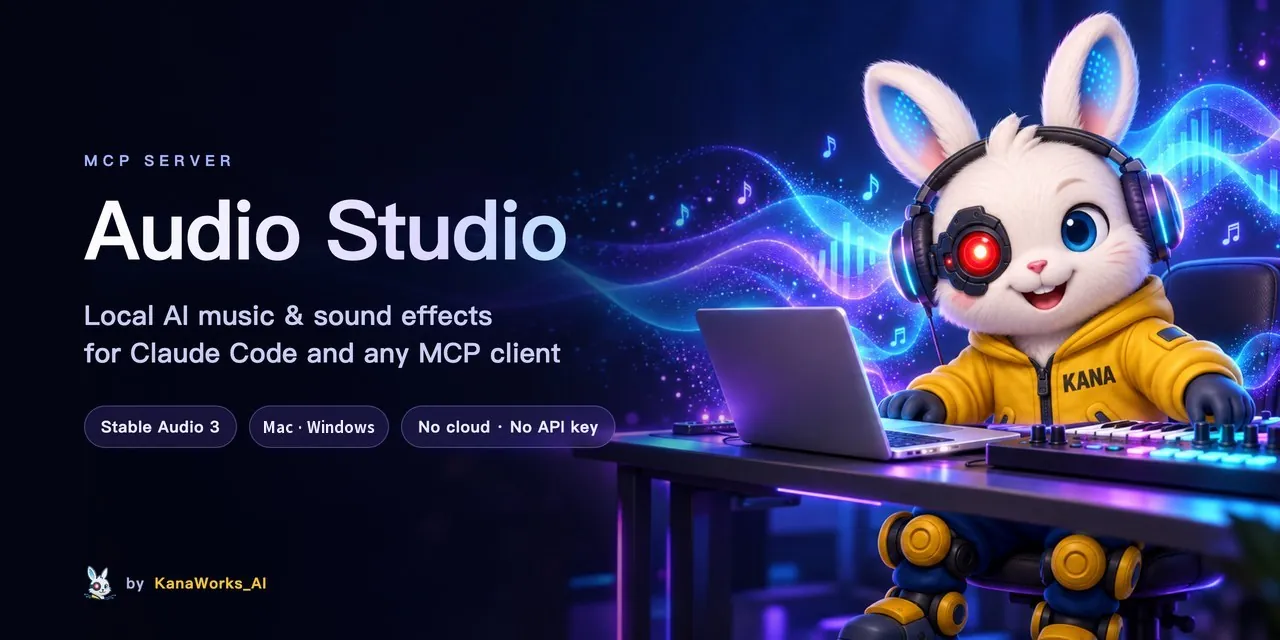
KanaWorks_AI released Audio Studio MCP on October 18, letting Claude Code or any MCP client generate background music and sound effects on the developer's own machine. According to the project's GitHub README, it uses Stable Audio 3 and is released under the MIT license.
Stable Audio 3 has its own separate license. The tool runs through MLX on Apple Silicon and through PyTorch on Windows machines with NVIDIA GPUs, so no cloud subscription is needed.
Beyond generating audio, it can loop and normalize clips and export them in game-ready formats, for example OGG for Godot. The launch post drew about 3,000 likes, and the repository had about 120 stars within a day.
Version 1.0, released on October 24, adds a local browser workbench, Make Game With AI reported. Developers can generate up to 4 takes of a prompt, regenerate a single section of a track, and export loops as WAV, OGG or FLAC.
Why it matters: audio has lagged behind code and art in agent-driven game development. With this tool, an agent that writes a level's code can also create its music and sound effects in the same session, without sending data to a cloud service.
Local generation also means no per-call costs and full control over the files. The 1.0 workbench reflects that generated audio usually needs a person to pick the best take and fix weak sections.
For solo developers and small teams, that could mean placeholder or even shippable audio without hiring a composer early on.
Caveat: AIGamer hasn't tested Audio Studio MCP, and the feature list comes from the project's own repository and Make Game With AI's coverage.
Before shipping generated audio commercially, developers will need to check the Stable Audio model license, which is separate from the tool's MIT license.