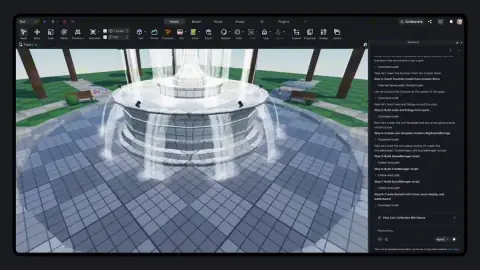
In a devlog posted on itch.io the same day, ohmplex writes that this is his first Unreal project and that it was built from November 12 by one person and one AI agent: Claude Code, running the Claude Fable 5.2 model, working inside Unreal Engine 5.9 through the editor's built-in MCP server, a local connection that lets an agent operate the editor's tools. He made the 2D art with ChatGPT while the agent built and tested. The devlog's count for November 15 is 15 Blueprints, which are Unreal's visual scripts, and 257 Python scripts, with "no C++, no Blueprint was wired by hand," and 186 messages from the developer to the agent.
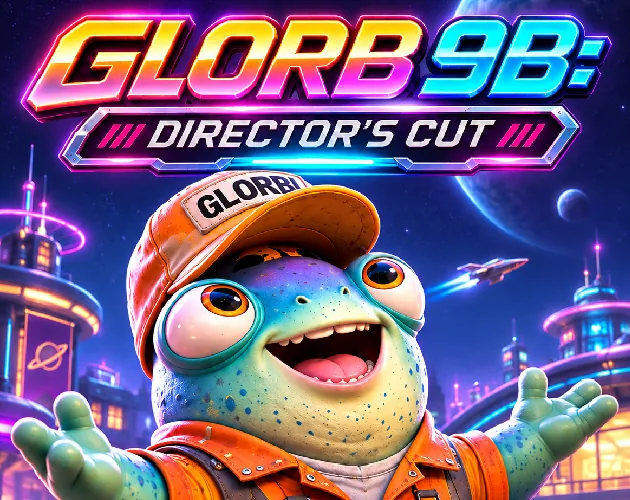
GLORB 9B: Director's Cut
- Windows
Summary
GLORB 9B: Director's Cut is a short arcade game for Windows from solo developer ohmplex (Olaf Ohm). Players are Glorbi, an alien janitor at the Glorb 9B spaceport, who scoops wobbly jelly litter onto a shovel, throws it into a bin on a timing bar and vacuums up puddles before they creep into open floor hatches, while an unseen voice cheers him on. The campaign asks for 1,000 points before the clock runs out; an Exhibition mode adds three levels (Plaza, Rain and Night), local high scores and a two-player hot-seat duel. It is an entry in Epic's 2026 AI MegaJam, whose theme was "Director's Cut", and went up on itch.io on November 15, 2026 as a 581 MB download at a name-your-own-price rate that starts at free.
Trailer
How it was made
Step 1 Plan the game in an interview
The devlog says the agent did not start by generating anything. It ran a short design interview, one question at a time with a recommendation for each, which ended in a written spec and a 13-task plan. The build order was set to protect the ending: jelly prototype first, the twist before the intro.
Step 2 Connect Claude Code to the Unreal editor
ohmplex writes that Unreal Engine 5.9's MCP server answered on the first try and offered 108 toolsets, and that the agent called it over HTTP with a 60-line helper script and reached Blender through its MCP add-on. The machine had no C++ compiler, so gameplay was written as Blueprints in text form with 5.9's text-based Blueprint tooling. A test package on day one failed until five editor-only plugins were restricted to the editor.
Step 3 Build the jelly twice
The blob was first modeled in plain Python as eight points on springs, with seven tests for how it wobbles, sags and slides off a tilted shovel. The same math was then written as a Blueprint, with the squashing done in the material. The devlog says the first measurement in the editor matched the Python model: a resting height of 21.73 cm in both.
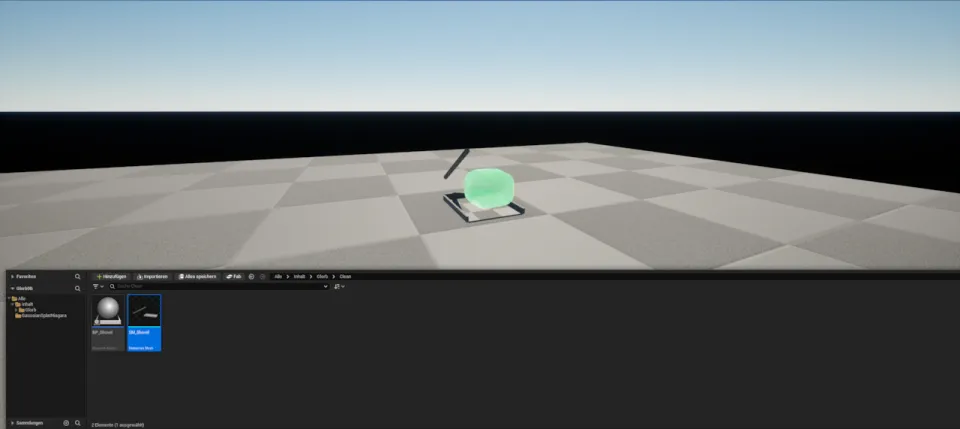
A green jelly cube resting on a flat shovel on a checkered test floor in the Unreal editor Image: ohmplex (itch.io devlog) Step 4 Change the design by playing
According to the devlog, almost every mechanic came from the developer picking up the mouse or gamepad and saying in one sentence what felt off. That is how a dropped blob came to break into pieces, how the vacuum became a second tool, and how puddles started creeping toward open floor hatches. On day two, carrying each blob to the bin was replaced by a timed throw.
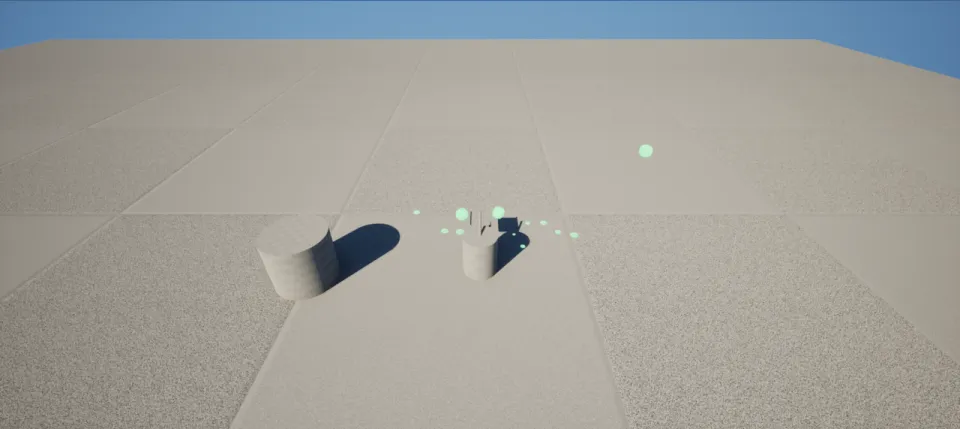
An early test scene: two gray cylinders on a bare floor with small green droplets scattered around one of them Image: ohmplex (itch.io devlog) 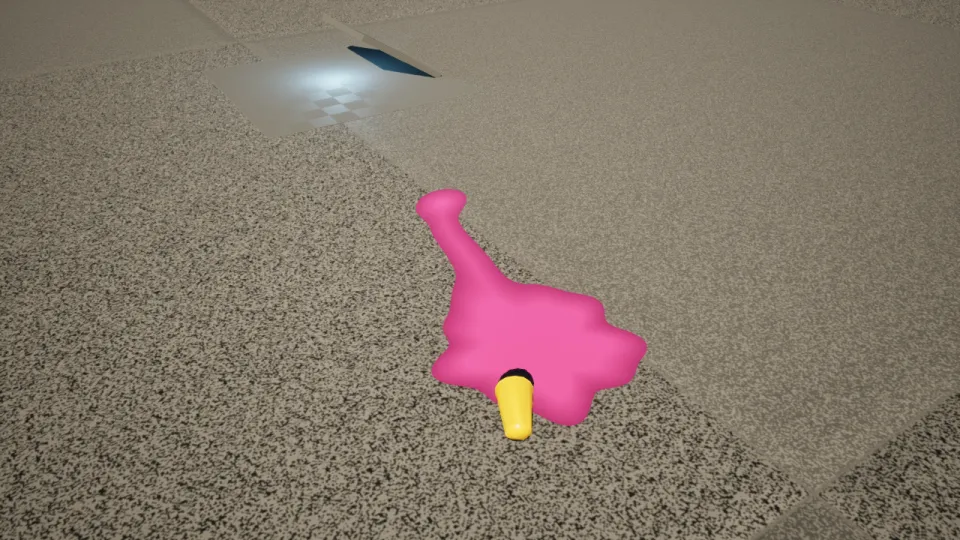
A pink puddle with a long tongue creeping across a speckled floor, a yellow cup lying at its edge Image: ohmplex (itch.io devlog) Step 5 Cut ChatGPT sheets into a set and a crowd
The developer generated sheets of characters, shop fronts, signs and plants with ChatGPT, and Python scripts cut the figures from their green background and packed them into atlases. In the game they are flat cut-outs that face the camera and switch between a front and a back view, and the shops are painted boards in front of plain blocks. The devlog calls the flat crowd a decision: there was no time to model, rig and animate hundreds of 3D creatures. It counts 71 2D characters in 145 pictures.
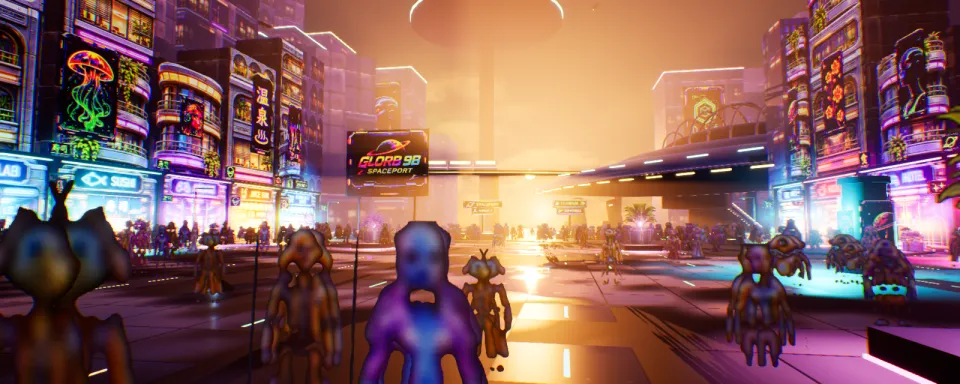
The neon spaceport plaza at dusk with flat alien figures walking toward and away from the camera Image: ohmplex (itch.io devlog) Step 6 Turn Meshy models into game characters
After a first stand-in built from simple shapes, the developer made Glorbi in Meshy from a ChatGPT concept sheet, at 1.5 million triangles. The devlog says Claude reworked it in Blender by script: down to 30,000 triangles, new UVs, color and normal maps baked from the original, a 19-bone skeleton and three animation loops. Six Meshy models are listed in all: Glorbi, his backpack, dustpan and vacuum nozzle, the bin and a soda can.
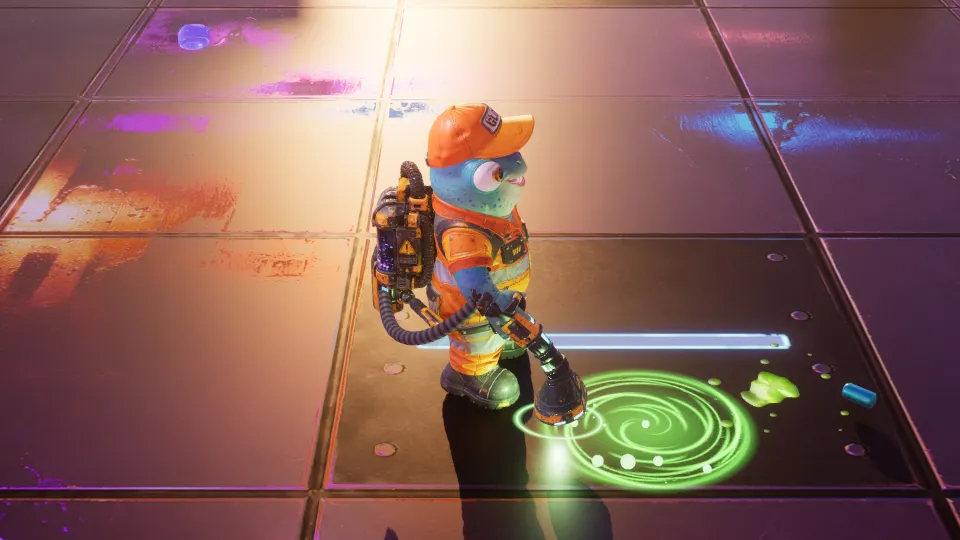
Glorbi in the released game: a blue frog-like janitor in an orange cap and suit, vacuuming a green swirl with a hose running to his backpack Image: ohmplex (itch.io) Step 7 Test the packaged build with real key presses
On the last day the developer found that Exhibition mode opened to a black screen in the packaged build, although every automated test had passed. The devlog says the tests started the level without a key press, and the bug only showed when the agent sent a real Enter key to the game window: the level was loading twice. The fix was one flag.
Sound came from two places, according to the devlog. Its tool list credits ElevenLabs with the director's voice, designed from a one-sentence description, plus sound effects and music tracks; its count for November 15 also lists 75 sound effects cut by script from 62 recordings the developer made himself. Two third-party assets are credited: two space panoramas from Space Spheremaps, and a CC BY 3.0 recording of Richard Strauss's "Also sprach Zarathustra" conducted by Philip Milman, used in the opening.
The itch.io page lists NVIDIA's DLSS 4.5 next to Unreal Engine 5.9. In the devlog, ohmplex writes that NVIDIA's DLSS plugin is offered for Unreal 5.5 to 5.8, so in the last hours of the jam he installed the build tools and the agent rebuilt the plugin from NVIDIA's source for 5.9, to qualify for the jam's NVIDIA prize. On the game page he wrote that his prompts to Claude alone ran to more than 50 pages and that making the game the conventional way "would have been impossible for me."
Caveat: the counts and the account of the process are the developer's own, from his devlog; AIGamer hasn't checked them against the project files or played the game. The itch.io listing carries an AI disclosure covering code, graphics and sounds. Epic's jam page says winners will be announced by January 29, 2027.
Sources
Details come from the developer's own posts and pages credited below.
- ohmplex on itch.io: GLORB 9B: Director's Cut by ohmplex (game page)
- ohmplex on itch.io: How Glorb 9B was built in 2.5 days – one human, one AI agent (devlog)
- itch.io: GLORB 9B: Director's Cut, submission to the 2026 Epic AI MegaJam
- Epic Games on itch.io: 2026 Epic AI MegaJam (jam page)
- OHMplex on YouTube: Glorb 9B: Director's Cut – Gameplay | 2026 Epic AI MegaJam
- AIGamer: Epic opens AI MegaJam with $65k in prizes after saying AI is optional
Image: ohmplex
Written in our own words; quotes are marked and credited. How we report