Home Resources Game building & playtesting
Ludra
Open-source game engine that AI agents build and test in
- Best for
- Developers who want a coding agent such as Claude Code to build a new 2D or 3D web game and prove it works before they play it
- Makes
- 2D and 3D browser games, exported as a single HTML file
- Made by
- Ludra contributors (Ersin, ersingvn on GitHub)
- Where you use it
- CLI
- Engines
- Web
- Pricing
- Free and open source under the MIT license (as of November 2026)
- Free plan
- Yes
- Open source
- Yes (MIT)
- Export
- `ludra build` writes the whole game to one HTML file plus a zip for uploading to itch.io, playable on any web host
- Status
- Available
Ludra is an open-source game engine meant to be driven by a coding agent rather than by a person in an editor. It was created by Ersin (ersingvn on GitHub) and is MIT licensed. According to the project's README, a game is a folder of plain JSON scene files plus optional TypeScript scripts, and each command gives the agent text it can act on.
The loop has four steps. ludra check validates the scenes and pairs every error with the JSON path and a suggested fix. ludra play runs the game headlessly from a list of timed inputs and returns events, an ASCII map and, if asked, real rendered screenshots. ludra test replays inputs and checks assertions such as won == true. ludra review flags signs of unfinished work, such as untested mechanics or the stock HUD. Later releases added ludra solve, which searches for a winning route, ludra fuzz, which runs random play sessions to find crashes and softlocks, and Ludra Studio, an Electron app that shows an agent's changes as the game runs.
It handles 2D games on arcade or Rapier physics and 3D games on Three.js and Rapier 3D, and ludra build exports a single HTML file for itch.io. It installs as a Claude Code plugin with a platformer skill, or from npm, and needs Node.js 22.18 or newer. AIGamer has not tested it. It suits new, agent-built web games; our guide to how coding agents playtest games covers it alongside similar tools.
Limitation: Games have to be made in Ludra's own JSON scene format, so it suits new projects rather than existing Unity, Godot or Unreal games, and the README still labels the engine early (v0.97, ahead of a planned v1.0)
FAQ
Is Ludra free?
Yes. Ludra is open source under the MIT license, and its packages are published free on npm as @ludra/cli and @ludra/core, according to the GitHub repository.
How do I install Ludra in Claude Code?
The README gives two commands to run inside Claude Code: `/plugin marketplace add ersingvn/ludra` and then `/plugin install ludra@ludra`. It can also be run without Claude Code via `npx @ludra/cli new my-game`. Node.js 22.18 or newer is required.
Can Ludra open my Unity or Godot project?
No. Games are built in Ludra's own JSON scene format with TypeScript scripts, so it is meant for new games rather than existing projects in other engines.
Can I publish a Ludra game on itch.io?
Yes. Since v0.96, `ludra build` exports the game as a single HTML file and a zip that can be uploaded to itch.io as an HTML game, according to the README.
Sources
Compiled by AIGamer from Ludra's own pages and the sources below, checked 20 November 2026. We haven't tested Ludra hands-on.
- ersingvn/ludra (GitHub): README
- ersingvn/ludra (GitHub): Releases
- ersingvn/ludra (GitHub): LICENSE (MIT)
- ersingvn/ludra (GitHub): Ludra Studio design notes
- npm: @ludra/cli
- AIGamer: How coding agents playtest games
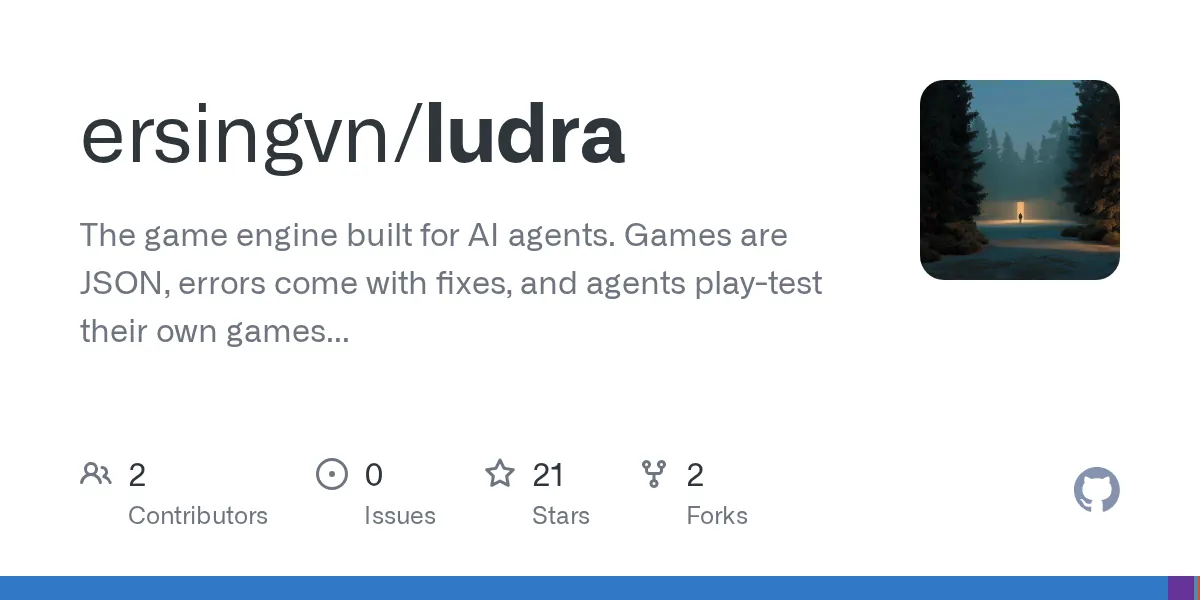
Image: Ludra (GitHub)
Written in our own words; quotes are marked and credited. How we report