The steps below draw on the project's README and the "Training" section of the model's Hugging Face card. The AI plays the villagers; the 3D characters and buildings are by Kenney (CC0).

Rumor Village
- Windows
- Linux
Summary
Rumor Village is a free rumor simulation game for Windows and Linux by Manuel García Sanz, released on GitHub on November 22. You pick some news (a party, a lottery prize, a fine), set where and when, choose who hears it first, then watch it spread and get twisted in a 3D village of 10 to 100 neighbors. It has six star-rated challenges, a free mode and a "Who did it?" round. In the download, a small language model trained for the game decides for every neighbor, offline on the player's graphics card. A browser demo plays on dice rules without AI; AIGamer started a game there on November 25.
Gameplay
How it was made
Step 1 Build training data from real games
Each decision starts from a short card: who the neighbor is, where, who is nearby and what they know. Cards were rebuilt from logs of real games by the engine's own code; two unnamed frontier models answered them, and the engine kept 12,146 valid pairs.
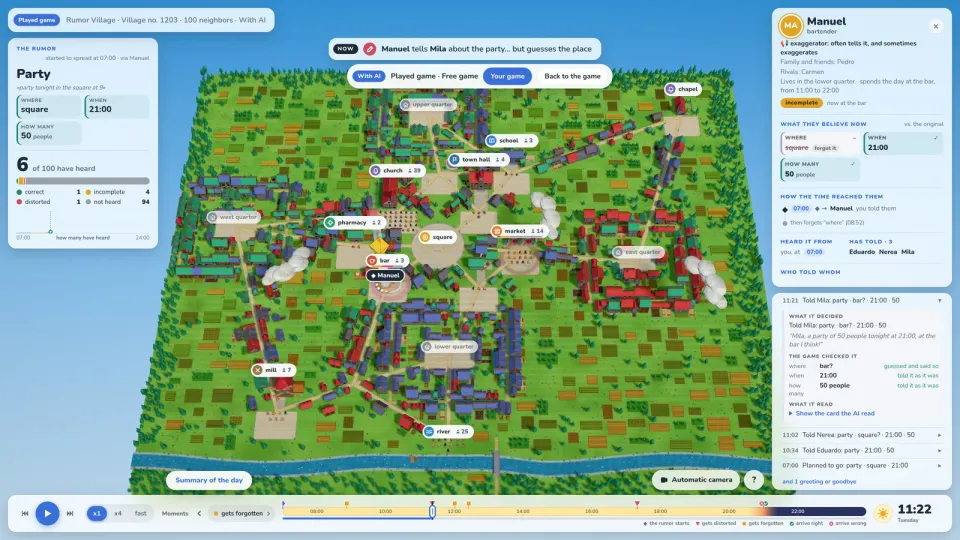
The game's "What did they think?" panel showing what a neighbor read and decided Image: Manuel García Sanz (GitHub) Step 2 Fine-tune Gemma 4 E4B with LoRA
He trained a LoRA (small add-on weights) on Google's Gemma 4 E4B on a rented RTX 5090, then merged and compressed it with llama.cpp to 5.34 GB. It reads a 256-token card instead of the base model's 921-token prompt.
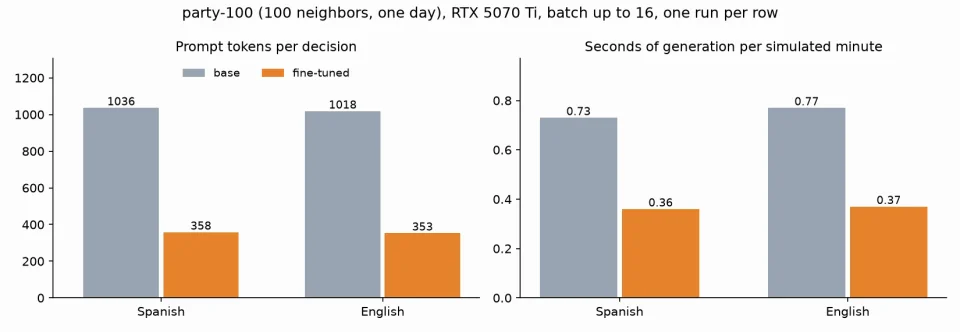
Bar charts from a 100-neighbor test run: prompt tokens per decision and seconds of generation per simulated minute, base against fine-tuned Image: Manuel García Sanz (Hugging Face) Step 3 Run every neighbor in one batch
A C++ engine sends every neighbor's decision to llama.cpp in one GPU batch. A grammar forces each reply into a JSON action (greet, tell, ask, say goodbye, go or do nothing) plus a speech-bubble line. "The model proposes and the engine decides," the README says.
Technical clip of many neighbors' decisions running in one batch, and the engine's verdict on an action Clip: Manuel García Sanz (Hugging Face) Step 4 Test base against fine-tuned
He compared both models on 1,000 held-out decisions per language and in village runs with matching seeds. In his split-screen recording, the base model gets stuck in endless chats; the fine-tuned one ends them.
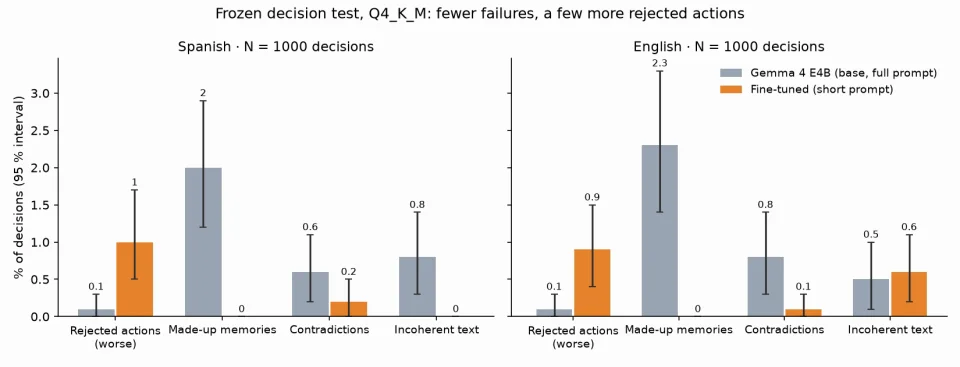
Chart of rejected actions, made-up memories, contradictions and incoherent text, base against fine-tuned Image: Manuel García Sanz (GitHub) 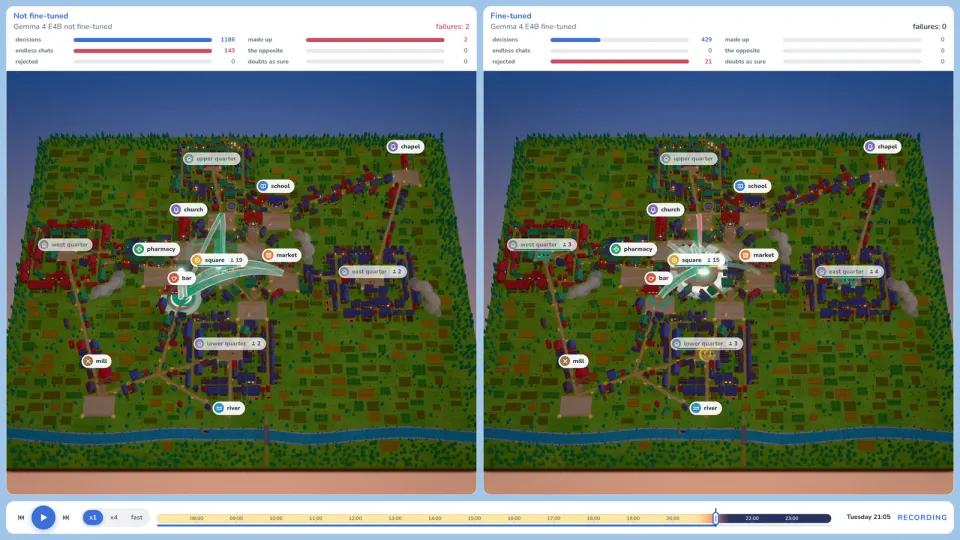
Split screen of the same village run by the base model and the fine-tuned model Image: Manuel García Sanz (GitHub)
In the developer's own frozen test, made-up memories fell from 2.0% (Spanish) and 2.3% (English) to zero, and failures were 16.5 times fewer in Spanish and 5 times fewer in English. He flags one regression: rejected actions rose from 0.10% to 1.0% in Spanish and 0.90% in English. On his RTX 5070 Ti, each simulated minute of a 100-neighbor day took 0.36 seconds of generation against 0.73 (Spanish), and an LLM judge scored naturalness 4.2 out of 5 against 3.7.
It shows one local route to AI characters: a small model trained on one game's rules, with the engine keeping the final say. Our guide to AI NPCs (https://www.aigamer.gg/guides/ai-npcs) covers others.
Caveat: all benchmark figures are the developer's own, from his hardware, and naturalness was scored by an LLM, not players. AIGamer hasn't played the With AI mode, which downloads a 5.34 GB model and needs a capable graphics card. There's no Mac build.
Sources
Details come from the developer's own posts and pages credited below.
- Manuel García Sanz (GitHub): Rumor Village repository and README
- Manuel García Sanz (GitHub): Rumor Village 1.0.0 release
- Manuel García Sanz (Hugging Face): rumor-village-e4b-GGUF model card
- Manuel García Sanz: Rumor Village official page
- Manuel García Sanz: Rumor Village web demo (Without AI)
Image: Manuel García Sanz
Written in our own words; quotes are marked and credited. How we report