HunyuanWorld-Voyager
Explorable 3D scene video from one image and a camera path
- Best for
- Researchers and teams with data-center GPUs who want to turn a single image into explorable, 3D-consistent scene video and point clouds
- Makes
- RGB and depth video along a chosen camera path, exportable as a 3D point cloud (PLY)
- Made by
- Tencent Hunyuan
- Where you use it
- Linux
- Pricing
- Free weights under Tencent's community license (self-hosted); not licensed in the EU, UK or South Korea
- Free plan
- Yes
- Open source
- No
- Export
- Generated RGB-D video can be exported as a PLY point cloud; Tencent claims no rights in outputs, within the license's territory
- Status
- Research
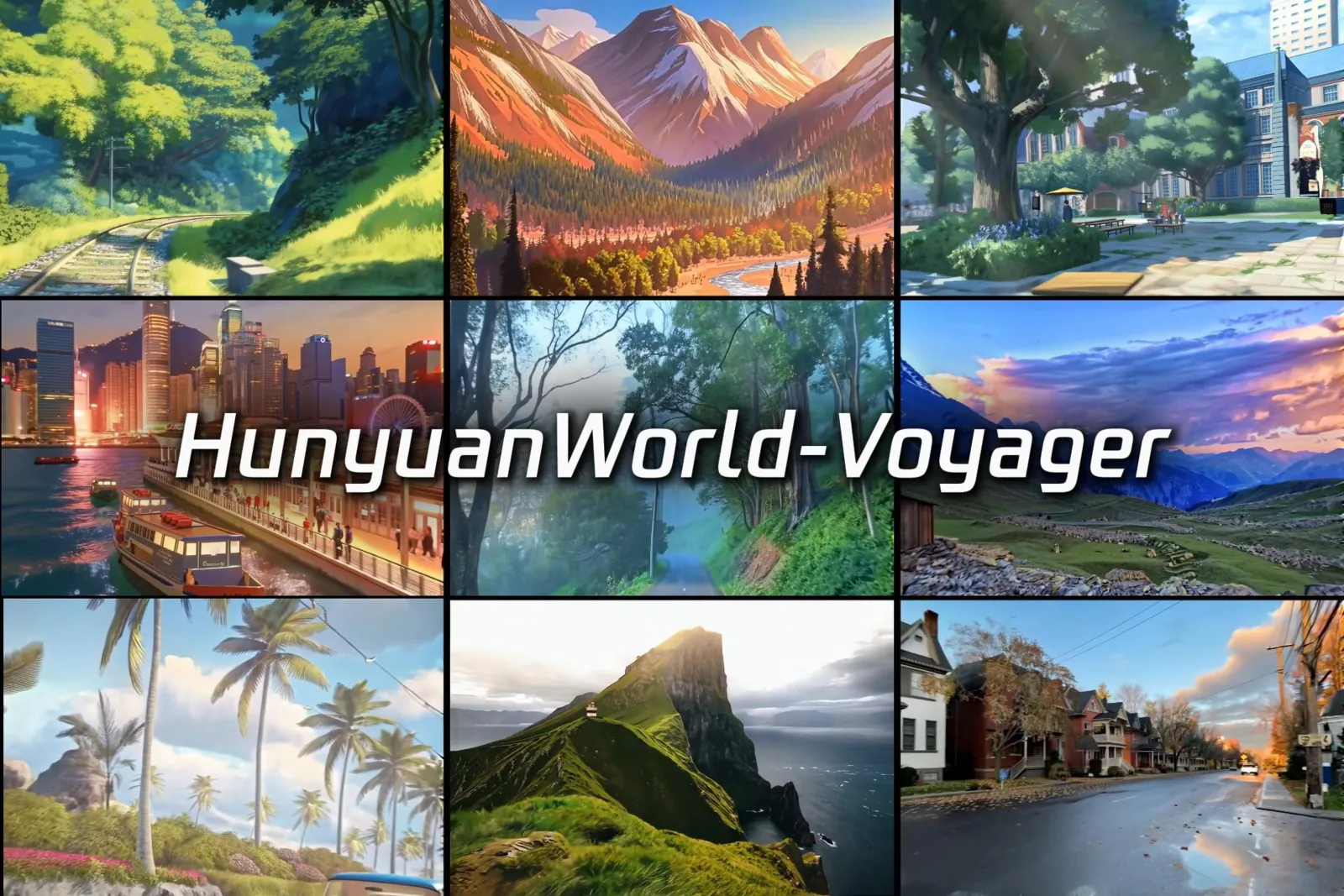
HunyuanWorld-Voyager is a video diffusion model from Tencent Hunyuan that turns a single image into video of a camera moving through the scene. You pick the camera path, and the model generates footage that stays consistent in 3D, along with a matching depth video that can be turned into a point cloud. Tencent released the code and weights on September 2, 2025.
According to the README, Voyager generates color and depth together and keeps a cache of the world it has already produced, so it can extend a scene step by step without contradicting earlier views. Its training set of more than 100,000 clips mixes real footage with Unreal Engine renders. The README's own benchmark table puts Voyager first on the WorldScore average; that result is Tencent's own.
The README lists 60 GB of GPU memory as the minimum for 540p and recommends an 80 GB card; Tencent tested it on Linux. A Gradio demo and multi-GPU inference are included.
The weights are free but not open source. Tencent's community license does not apply in the European Union, United Kingdom or South Korea, requires licensees whose products had more than 1 million monthly active users at the model's release to ask Tencent for a separate license, and bans using outputs to improve other AI models.
For game developers, Voyager is a research tool for previsualizing environments or making 3D reference from concept art, not a game engine. Tencent has since released HY-World 2.0. AIGamer has not tested Voyager.
Limitation: Needs an NVIDIA GPU with at least 60 GB of memory for 540p (80 GB recommended), and the license excludes the EU, UK and South Korea
FAQ
Is HunyuanWorld-Voyager free?
The code and weights are free to download and run yourself under Tencent's HunyuanWorld-Voyager Community License, which has conditions on territory and company size.
Can I use HunyuanWorld-Voyager in the EU or UK?
No. The license says it does not apply in the European Union, United Kingdom or South Korea, and use outside its territory is not licensed.
What GPU does HunyuanWorld-Voyager need?
The README lists a minimum of 60 GB of GPU memory for 540p video and recommends an 80 GB GPU. It was tested on Linux.
Can Voyager make 3D scenes for games?
It generates RGB and depth video that can be exported as a PLY point cloud, which is useful as 3D reference. It does not output game-ready meshes.
Sources
Compiled by AIGamer from HunyuanWorld-Voyager's own pages and the sources below, checked 3 November 2026. We haven't tested HunyuanWorld-Voyager hands-on.
- GitHub (Tencent Hunyuan): Tencent-Hunyuan/HunyuanWorld-Voyager README
- GitHub (Tencent Hunyuan): Tencent HunyuanWorld-Voyager Community License Agreement
- Hugging Face (Tencent): tencent/HunyuanWorld-Voyager
- Tencent Hunyuan: HunyuanWorld project page
Image: Tencent Hunyuan
Written in our own words; quotes are marked and credited. How we report