vork
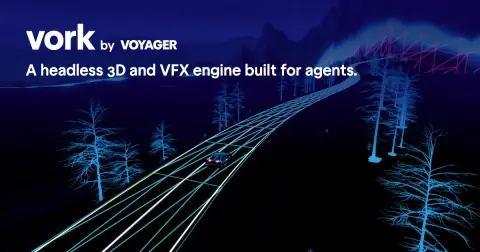
Headless 3D and VFX renderer that AI agents drive as code

- Best for
- Developers who want a coding agent to write, render and revise 3D shots, trailers or VFX as code on a recent NVIDIA GPU or Apple Silicon Mac
- Makes
- Rendered 3D stills and video, including VFX composited onto real footage
- Made by
- Voyager (Nullframe, Inc.)
- Where you use it
- Windows, macOS, Linux, CLI
- Pricing
- Free during the research preview, including commercial use (as of November 2026); optional Voyager cloud GPUs are billed by the second and need a paid Voyager workspace, from $19/month
- Free plan
- Yes
- Open source
- No
- Export
- Renders to image and video files (PNG stills, MP4 clips) and imports glTF models; the license says Voyager claims no rights in the scenes, code or media you make
- Status
- Research
vork is a headless 3D and VFX rendering engine from Voyager, the company behind a desktop AI agent for creative work. There is no editor or window. A coding agent describes the scene in JSON (directly or through the Python and TypeScript SDKs), renders it from the command line, checks the output and adjusts the scene until the shot works. According to the project's README, scenes can also carry small GPU programs written in Slang that change materials, cameras, light, simulation and compositing without touching the renderer. The engine itself is written in Rust and Slang and renders through Vulkan and Metal.
Voyager says the getting-started help an agent reads is about 2,500 tokens, including a complete first scene. Version 0.1.0 was released on GitHub on November 6, 2026, as a research preview.
For game developers, vork is a way to have an agent produce rendered shots, such as trailer footage, key art or effects tests, rather than a place to build a game. Voyager's own blog says it is not a game engine, and its documentation describes no input handling or gameplay runtime.
It runs locally on Windows and Linux with a recent NVIDIA GPU that supports hardware ray tracing, or on Apple Silicon Macs running macOS 26. Voyager also rents cloud GPUs that run vork, billed by the second from a paid workspace. The code is public but source-available, not open source, and free during the preview. AIGamer hasn't tested it.
Plans and pricing
| Plan | Price | What you get |
|---|---|---|
| vork 0.1.0 research preview | Free | Local install; free including for commercial work under the vork Preview License |
| Vork Cloud (Voyager cloud GPUs) | Billed by the second | Needs a paid Voyager workspace (Starter, $19/month billed monthly, or above); live GPU prices are shown on Voyager's dashboard |
From vork's own pricing page, checked 7 November 2026. Prices change; check before you buy.
Limitation: Research preview: fog and volumes are ignored, large scenes and dense transparency can fail (including on Mac), and its path tracer was slower than Blender's Cycles in the project's own tests
FAQ
Is vork open source?
No. The code is on GitHub under the vork Preview License, which calls it source-available. You can use and modify it for your own work, including commercially, but you can't sell it, distribute modified versions or run it as a hosted rendering service without Voyager's permission.
Is vork free?
Yes, during the research preview, including for commercial work. The license says later versions may come under different terms, including paid ones. Rendering on Voyager's cloud GPUs costs extra and needs a paid Voyager workspace.
Can I make a game with vork?
Not directly. Voyager's blog says vork is not a game engine, and its documentation describes no input handling or gameplay runtime. It renders images and video from scenes, so it suits trailers, key art and VFX shots.
What hardware does vork need?
Per the README, Windows 10/11 or Linux (Ubuntu 22.04 or newer) with a recent NVIDIA GPU and a Vulkan driver with hardware ray tracing, or an Apple Silicon Mac (macOS 26 for the bundled Slang compiler). Voyager's blog adds that AMD and Intel GPUs, Intel Macs and software rendering are not supported, and the README says data-center GPUs such as the A100 and H100 lack the ray tracing it needs.
Sources
Compiled by AIGamer from vork's own pages and the sources below, checked 7 November 2026. We haven't tested vork hands-on.
- Voyager: vork: a headless 3D and VFX engine for agents (product page)
- GitHub (voyager-so/vork): vork README
- GitHub (voyager-so/vork): vork Preview License
- GitHub (voyager-so/vork): Release vork 0.1.0
- Voyager blog (Ravi Parikh): What is vork? The headless 3D and VFX engine for agents, and its limits
- Voyager: Vork Cloud: run vork on Voyager cloud GPUs
- Voyager: Pricing
- Ravi Parikh (@ravisparikh) on X: Announcement post
- Voyager: FAQ
Image: Voyager (car model: "Car Concept" by Unity Fan, CC BY 4.0)
Written in our own words; quotes are marked and credited. How we report