Atlas
3D worlds from images, with splat and mesh export
- Best for
- Developers who want to turn photos, generated images or a graybox into a 3D scene they can export as splats or a GLB mesh
- Makes
- Gaussian splat scenes (SPZ), GLB meshes with optional box colliders, camera-path video and images
- Made by
- World Labs
- Where you use it
- Web, CLI
- Engines
- Blender
- Pricing
- Pay-as-you-go API credits at 1,000 per $1; full task rate card and Atlas Studio subscription prices not published (as of November 2026)
- Open source
- No
- Export
- Gaussian splats as SPZ files and meshes as GLB (optionally with a second GLB of box colliders), plus images and video; splat files import into Blender 5.3, per World Labs' docs
- Status
- Available
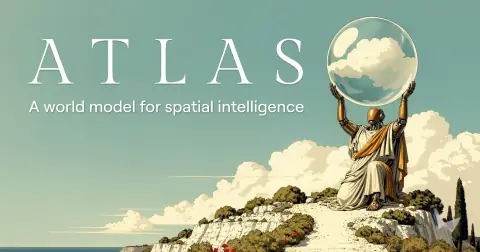
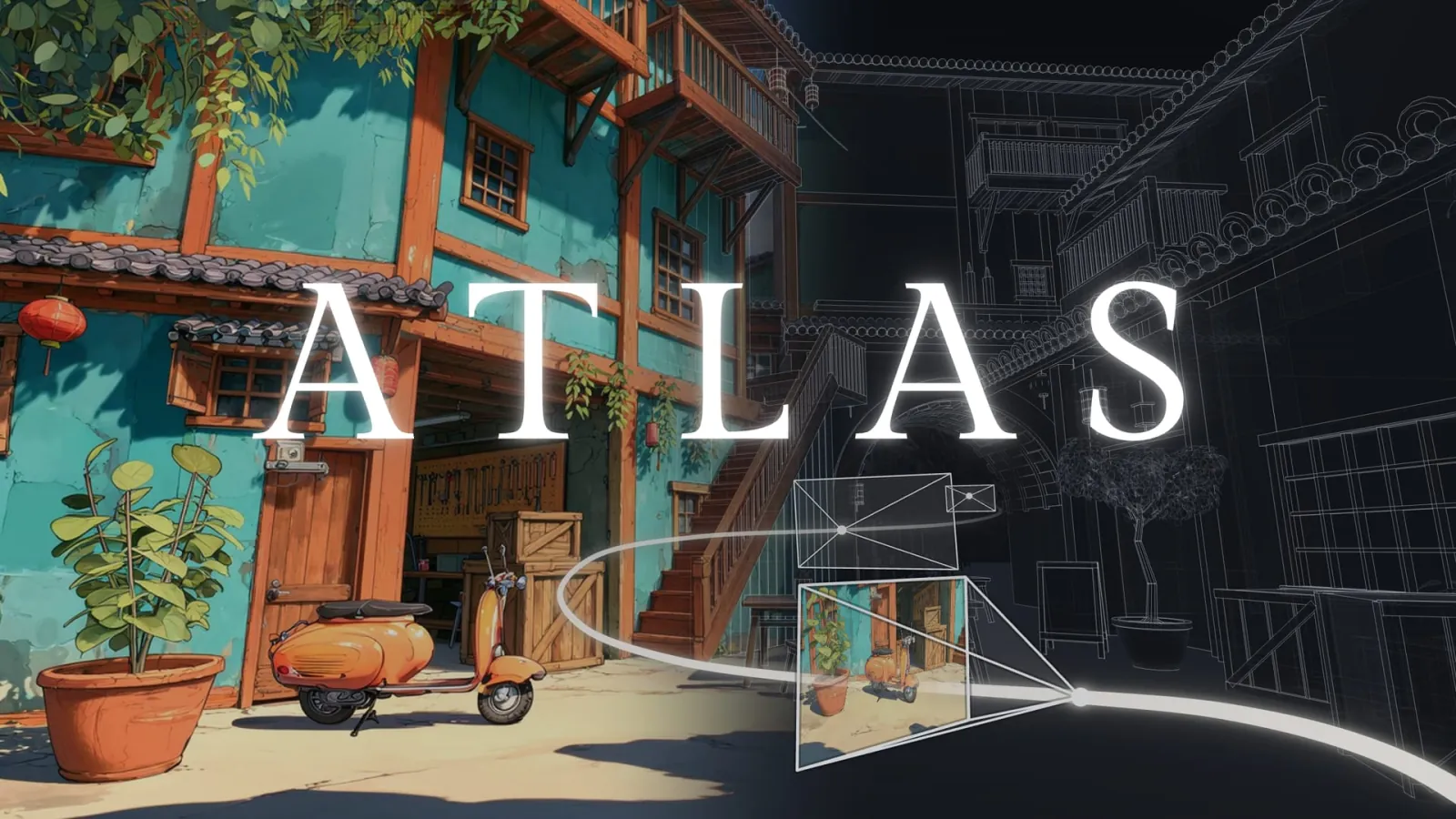
Atlas is World Labs' world model for generating and reconstructing 3D scenes. The company introduced it in a blog post on September 1, 2026, and opened it to everyone on November 12, 2026, it said on X.
There are two browser apps. Viewfinder builds a scene from one image, or reconstructs a real place from as many as 64 inputs, and exports images, video or 3D Gaussian splats (scenes stored as small colored blobs, not polygons), according to World Labs' X thread. Chisel starts from a graybox, a rough 3D layout, and renders it in a chosen style. World Labs' product page also names Splats to Mesh and Relight under "Tools launching with Atlas".
For game developers the relevant part is the developer API, whose docs list six tasks, among them posedImages2Splats, which returns an SPZ splat file, and splats2Mesh, which converts a splat into a GLB mesh with optional textures, a face-count cap and box colliders. The docs also cover a command-line tool, a hosted MCP server, a Blender extension and agent skills for Claude Code, Codex and Cursor, published on GitHub under the Apache-2.0 license. The model itself is not open source.
Billing is by credits at 1,000 per US dollar. The docs price a refined splat scene at 5,000 credits ($5) and a draft at 500, and point to a rate card inside the platform for other tasks. Rate limits are "To be announced".
AIGamer has not tested Atlas. World Labs' benchmark figures are its own.
Plans and pricing
| Plan | Price | What you get |
|---|---|---|
| Developer API credits | $1 per 1,000 credits | Purchased credits do not expire. Refined splat scene: 5,000 credits ($5); draft splat scene: 500 credits ($0.50); failed runs are free. For other tasks the docs point to a rate card inside the platform. |
| Frameboy session (Atlas Studio) | 500 credits ($0.50) | Real-time session of up to a minute; free if it plays for less than 5 seconds. |
From Atlas's own pricing page, checked 14 November 2026. Prices change; check before you buy.
Limitation: The mesh converter only meshes geometry its render cameras can see, and World Labs' docs say splats can show artifacts in sky, foliage, thin structures, windows and large open spaces
FAQ
Is World Labs Atlas free?
World Labs has not published a free plan or a full price list. Its docs say developer API tasks draw on credits bought at 1,000 per US dollar, with a refined splat scene costing 5,000 credits ($5), and point to a rate card inside the platform for other tasks. The error docs mention a "Free seat" and "signup credits" in the web app, without amounts (as of November 2026).
Can Atlas export a mesh for a game engine?
Yes, according to World Labs' API reference. The splats2Mesh task converts a Gaussian splat into a GLB mesh with an image texture, vertex colors or no texture, and can also return box colliders as a second GLB. World Labs has not published mesh quality benchmarks, and AIGamer has not tested the output.
Does Atlas work with Claude Code, Codex or Cursor?
World Labs publishes open-source agent skills (Apache-2.0) that install as a plugin for Claude Code and Codex, and through its CLI for other agents such as Cursor and Gemini CLI. It also hosts an MCP server at https://api.atlas.worldlabs.ai/mcp that needs a sign-in but no API key.
What is the difference between Atlas and Marble?
Marble is World Labs' first product, for creating 3D worlds from images, video, text and 3D layouts. Atlas is the company's newer world model, with its own apps and developer API; its quickstart tells developers not to use examples written for the older Marble or World APIs.
Sources
Compiled by AIGamer from Atlas's own pages and the sources below, checked 14 November 2026. We haven't tested Atlas hands-on.
- World Labs: Atlas (product page)
- World Labs (@theworldlabs) on X: Thread opening Atlas to everyone, November 12, 2026
- World Labs: Atlas: A World Model for Spatial Intelligence (blog post)
- World Labs: Developer docs: Task overview
- World Labs: Developer docs: splats2Mesh API reference
- World Labs: Developer docs: Billing
- World Labs: Developer docs: Posed images to splats
- World Labs: Developer docs: Make splats
- World Labs: Developer docs: Rate limits
- World Labs: Developer docs: Errors and retries
- World Labs: Developer docs: Skills and plugins
- World Labs: Developer docs: CLI
- World Labs: Developer docs: MCP server
- World Labs: Developer docs: Blender
- World Labs: Developer docs: Splat best practices
- World Labs: Developer docs: Quickstart
- World Labs: worldlabsai/skills (GitHub repository, Apache-2.0 agent skills)
- World Labs: About
Image: World Labs
Written in our own words; quotes are marked and credited. How we report