UniRig
Automatic skeleton rigging and skinning for 3D models
- Best for
- Developers and technical artists who want to auto-rig generated or downloaded 3D characters and creatures before animating them
- Makes
- Rigged 3D models: a predicted skeleton plus per-vertex skinning weights, exported as FBX or GLB
- Made by
- VAST AI Research (Tripo) and Tsinghua University
- Where you use it
- CLI
- Pricing
- Free, open source (self-hosted)
- Free plan
- Yes
- Open source
- Yes (MIT)
- Export
- Takes OBJ, FBX, GLB or VRM input and writes rigged FBX or GLB files you can use in other tools
- Status
- Research
UniRig is an open-source model that rigs 3D models automatically: it predicts a skeleton and then the skinning weights that tie the mesh to those bones. It comes from Tsinghua University and Tripo (VAST AI Research), and the paper was published at SIGGRAPH 2025.
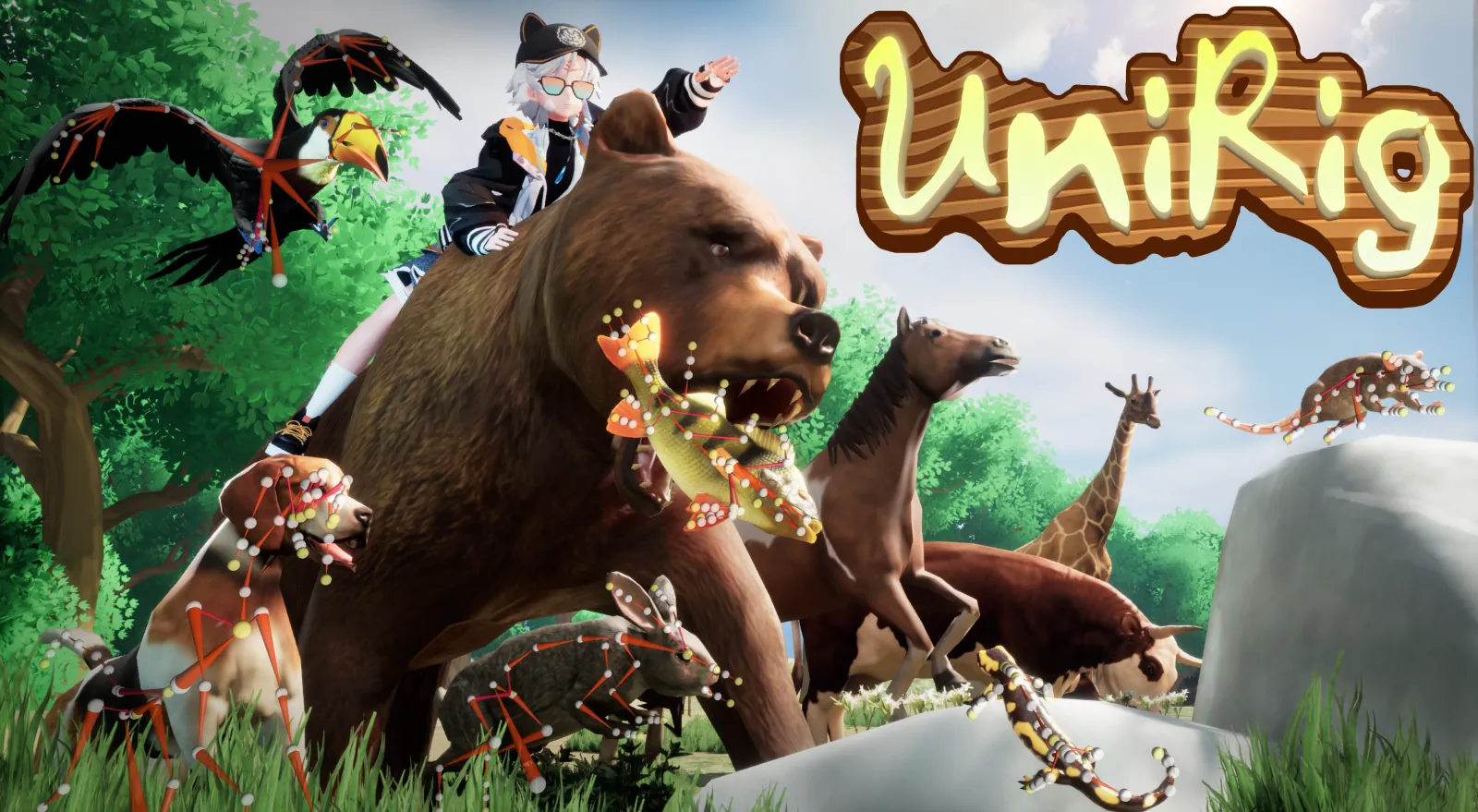
According to the project's README, rigging runs in two stages. A GPT-style transformer predicts a valid bone hierarchy one token at a time, then a second network works out how much each bone moves each vertex. The same model is meant to work across people, animals and objects; the README shows an animated dragon and rabbit, and its sample input is a giraffe. It accepts OBJ, FBX, GLB and VRM files and outputs rigged FBX or GLB.
The code is MIT-licensed and free. The README says generation needs a CUDA GPU with at least 8 GB of VRAM, and installation involves several CUDA-specific packages. The released checkpoint is trained on the Articulation-XL2.0 dataset; the full model trained on Rig-XL and VRoid from the paper is still listed as a future release, as is bone-attribute prediction for physics.
For game developers, UniRig fills the step between generating a mesh (with tools such as Tripo or TRELLIS) and animating it. The team now points users to SkinTokens, a successor that combines both stages. AIGamer has not tested UniRig.
Limitation: Needs a CUDA GPU with at least 8 GB of VRAM, and the released checkpoint is trained on Articulation-XL2.0, not the full Rig-XL/VRoid model behind the paper's main results
FAQ
Is UniRig free?
Yes. The code is open source under the MIT license, and the model checkpoint is on Hugging Face. You run it on your own GPU.
What file formats does UniRig support?
The README lists OBJ, FBX, GLB and VRM as input formats. Results are written as FBX, and the merge step outputs a rigged GLB.
What hardware does UniRig need?
The README says generation needs a CUDA-enabled GPU with at least 8 GB of VRAM.
Can UniRig rig animals and non-human characters?
The project says one model is meant to cover people, animals and objects. The README shows an animated dragon and rabbit, and its sample input model is a giraffe.
Sources
Compiled by AIGamer from UniRig's own pages and the sources below, checked 3 November 2026. We haven't tested UniRig hands-on.
- GitHub (VAST AI Research): VAST-AI-Research/UniRig README
- arXiv: One Model to Rig Them All: Diverse Skeleton Rigging with UniRig
- Hugging Face (VAST-AI): VAST-AI/UniRig
- UniRig project page: UniRig
- GitHub (VAST AI Research): SkinTokens
Image: UniRig (Tsinghua University and Tripo / VAST AI Research)
Written in our own words; quotes are marked and credited. How we report